Trick 1The four shadows
One boat, four views: the plan (from above, that’s the big oval), the profile (from the side), and the bow and stern faces. Four flat shadows are all it takes to describe a whole hull on a single sheet of paper.
The naval architecture corner
In 1986, Berkeley Eastman folded an entire harbor tug into fourteen trailerable feet, and in 1997 David Cronk drew Sheet 1. Pull up a stool: this page teaches you to read that sheet, explains why the little tug is shaped the way she is, and then hands you the pencil so you can redesign her yourself.
Sheet 1 of 1
A blueprint looks like secret code until someone shows you the four tricks. Here’s the actual CANDU E-Z sheet (the very design AWOOGA was built from) and everything you need to read it like a shipwright.
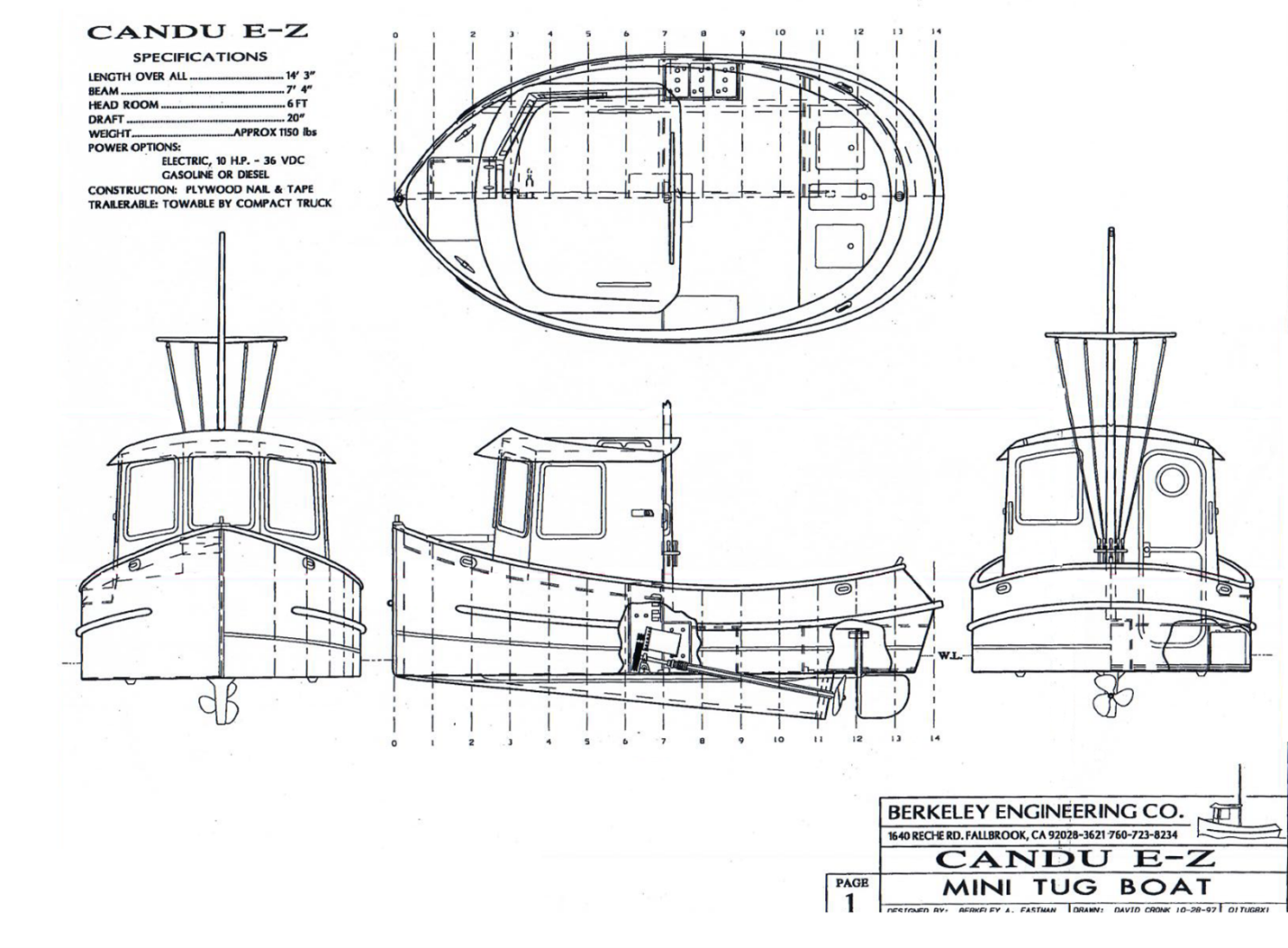
One boat, four views: the plan (from above, that’s the big oval), the profile (from the side), and the bow and stern faces. Four flat shadows are all it takes to describe a whole hull on a single sheet of paper.
The dashed vertical lines numbered 0 to 14 are stations, slices through the hull, one per foot, like a CT scan of a boat. Every frame, bulkhead and curve in the plans is located by its station number.
The long horizontal line marked W.L. is where the sea agrees to hold her. Everything below it is displacement doing quiet, honest work; everything above it is freeboard, cabin and charisma.
The boxed corner is the sheet’s pedigree: Berkeley Engineering Co., Fallbrook, CA, designed by Berkeley A. Eastman, drawn by David Cronk, dated 10-28-97. When a drawing signs its work, you can trust its lines.
Top-left corner of the sheet
Eight little lines of type, one entire philosophy of boatbuilding. Here’s what each line of the official specification actually means.
Design decisions, decoded
Nothing on the sheet is an accident. Four quiet decisions make the CANDU E-Z buildable in a garage, stable in a chop, and unmistakably a tug.
Her bottom is flat and her sides meet it at a crisp angle: a hard chine. Round bilges need lofting and torture-bent planks; flat panels come straight off a sheet of plywood. It also means shallow draft and a boat that sits upright on a trailer like it was born there.
A length-to-beam ratio near two makes naval architects raise an eyebrow and tugboats feel at home. The width is what buys standing headroom, a stable platform, and that unmistakable pushed-together working-boat profile, scaled down without being watered down.
She rides in the water, not on top of it. That caps her speed at “hull speed,” a number set by waterline length and pure physics, roughly five knots for a boat this size. No engine changes it. Tugs accepted this bargain centuries ago: all pull, no hurry.
The build method in the spec box is the whole reason ordinary people finish these boats: cut plywood panels, nail them over a handful of frames, seal every seam with epoxy and fiberglass tape. It’s the exact recipe AWOOGA was built with: do-overs, learning curve and all.
Now you hold the pencil
Three sliders, live physics. Stretch her, squeeze her, over-power her: the drawing redraws itself and the numbers tell you what kind of boat you just invented. Berkeley Eastman’s answer is one of the presets; see if you land anywhere near it.
Builders famously stretch the E-Z a foot. Famously.
Width is stability, headroom and attitude.
The sheet says 10. AWOOGA said 20. Physics says “cute.”
Load a design
The committee’s verdict: this is the boat exactly as Berkeley Eastman drew her: properly tubby, honestly powered, and towable home behind a compact truck. Hard to improve. People keep trying anyway.
All figures are proud napkin math: hull speed as 1.34 × √LWL, weight and plywood scaled from the sheet and from AWOOGA’s real build. Wonderful for arguing at the dock; do not cite this page in your naval architecture thesis.
Designed vs. built
No CANDU E-Z has ever been built exactly to the sheet: deviating from the plans is a proud builder tradition, and AWOOGA upheld it enthusiastically. Here’s her official scorecard.
| Line item | The 1997 sheet says | AWOOGA, as built |
|---|---|---|
| Length over all | 14′3″ | 14′3″The one number that survived contact with the builder. |
| Beam | 7′4″ | 7′0″Four inches shy of the sheet, close enough that the drawing never noticed. |
| Draft | 20″ | ≈17″Even less to ask of the sea. |
| Power | Electric 10 HP – 36 VDC, gas or diesel | 20 HP Tohatsu outboardDouble the spec. The surplus is stored as attitude. |
| Construction | Plywood, nail & tape | Meranti marine ply, fiberglass cloth & epoxySame recipe, fancier flour. |
| Air Horn | (not specified) | Wildly out of scaleSome deviations are the whole point. |
Sheet values as printed on the original drawing; as-built values per AWOOGA’s press kit. Discrepancies between paper and boat are settled, as always, in the builder’s favor.
Bonus exhibit · recovered from the drafting table
In 1997, Berkeley Engineering drew the CANDU E-Z with the quiet dignity of a real working boat. Then Adam got hold of the drawing. Drag the pencil across the sheet, or press the button and let the attitude take over. And here’s the part nobody asked about: AWOOGA wasn’t even the first idea. There was a pitch meeting. It did not go well.
Original drawing: Berkeley Eastman / Berkeley Engineering & Research. The “improvements” are entirely Adam’s fault. The other ten pitches, somehow, also Adam’s fault.
Leaving the drafting table?
Now that you can read the sheet, the rest of the harbor makes more sense.
